
Rivers
The Illinois River starts just south of Cave Junction, where its East Fork and West Fork meet. From there the main river runs about 56 miles past Kerby, into the national forest and the Kalmiopsis country, and on to the Rogue River at Agness. The water is clear: the federal Wild and Scenic Rivers program says you can often see 15 feet or more into its blue-green pools.
It is also cold, fast in places, and far from help once you leave the highway.
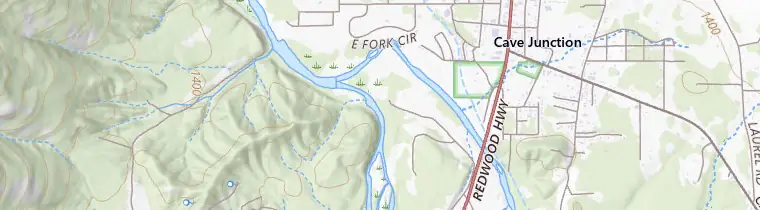
Illinois River Forks State Park
Illinois River Forks State Park sits at the confluence itself, off US-199 just south of town. Oregon Parks and Recreation Department runs it as a day-use park, and its own listing showed it open with no day-use fee when we checked in November 2026. There's no camping.
What you'll find:
- Picnic tables, a vault toilet, and a picnic shelter you can reserve for groups of up to 50 (800-452-5687).
- A short walking trail and a 9-hole disc golf course.
- Leashed dogs are welcome. Bring a bag.
Where the forks meet, a long, calm stretch draws summer swimmers. Rogue Riverkeeper, a river conservation group, tests the water there for E. coli every 2 weeks in summer and posts the results on Swim Guide. The sample from September 8, 2026 passed.
State Parks warns of swift currents and hidden obstructions under the surface, and asks swimmers and boaters to wear a life jacket that fits. Park info: (541) 582-3128, or see the park page.
Swimming farther downstream
Two popular swimming spots are on the Wild and Scenic stretch, reached from Selma by the Illinois River Road off US-199. Both are Rogue River-Siskiyou National Forest sites:
- Store Gulch, about 9 miles from Selma, has a day-use area with a sandy beach and deep pools that are popular for jumping off the rocks. A small campground sits just past it.
- Six Mile Day Use has 2 log picnic pavilions reached by a small footbridge over Six Mile Creek. The Forest Service describes it as a quieter site with less beach access. It has no toilets, no drinking water, and no trash service, so pack everything out.
The Illinois River Road is narrow, with blind corners, and becomes unpaved and rough past the Swinging Bridge turnoff. Cell coverage is limited. The Forest Service also enforces parking limits along the road and posts fire rules and seasonal closures on its alerts page. In 2026 it banned alcohol along the river corridor, including Six Mile and Store Gulch, through September 30.
Staying safe in the water
- It's cold. The Forest Service notes the river stays cold all year, even when the valley is hot.
- Wear a life jacket. Both State Parks and the Forest Service ask for one, for adults and kids.
- Watch for hidden rocks and logs before you jump, and check the depth every time.
- Nobody is watching. None of these spots has a lifeguard.
Rafting and kayaking
Below the national forest boundary, 50.4 miles of the Illinois have been a federal Wild and Scenic River since 1984. The wildest part runs about 29 miles through a steep canyon with roughly 150 rapids, including 11 at Class IV and 1 at Class V, according to the national Wild and Scenic Rivers listing. There are no roads in that canyon. It's a trip for experienced whitewater boaters or for a guided group, not for an inner tube.
- Permits: the Forest Service requires a permit for the wild section all year, at no charge. The main boating season is March to mid-May, while there's enough water.
- Guided trips: Northwest Rafting Company runs 4-day Illinois River trips in April and May, meeting in Grants Pass, for ages 16 and up. It works under a Forest Service special-use permit.
- Closer to home: Out 'n' About Treesort in Takilma offers summer rafting as one of its guest activities. See Where to stay.
- The Rogue: the Wild Rogue starts at Grave Creek, northwest of Grants Pass, and the Bureau of Land Management issues its float permits at the Smullin Visitor Center at Rand, 14335 Galice Road, Merlin. Many Rogue outfitters are based around Galice and Merlin.
For quieter paddling on flat water, see Lake Selmac on Lakes and mountains.
Fishing
The Illinois is a wild salmon and steelhead river with no hatchery stocking. Coho and Chinook salmon, winter steelhead, and cutthroat trout all use it. Rules change by stretch and by season, and some parts close to all fishing in the fall. Check the Oregon Department of Fish and Wildlife's regulations and its Recreation Report for the Southwest Zone before you cast.
One change worth knowing: the old Pomeroy Dam, a diversion dam on the Illinois near Cave Junction, was removed in 2024. ODFW's 2026 to 2027 rules now use the confluence of the East and West Forks as a boundary in place of the dam site.
What we left out
We couldn't find a rafting business called Wild River Rafting operating in 2025 or 2026. The Wild River name in town belongs to Wild River Brewing & Pizza (see Eat and drink). If you know of a current local outfitter, send us a correction.