
Illinois Valley history
The Illinois Valley's written history starts with gold. Within a few years of the first strike, the valley had a county seat and a fort, and later one of the country's first smokejumper bases. Here is that story, and what's actually left to see.
Gold at Sailors' Diggings and Waldo
In the early 1850s, a party of sailors found rich gold placers in the south end of the valley. Sources disagree on the year: the state's Blue Book says 1852, and the National Register nomination for the town's cemetery says 1851. The camp was called Sailors' Diggings, and it set off a rush that brought settlers into the region.
The camp was renamed Waldo for William Waldo, a Whig candidate for governor of California who campaigned there in 1853, apparently thinking the town was in California. When Josephine County was created in 1856, Waldo became its first county seat, and a post office opened that September. At its peak it had a hotel, a brewery, a bowling alley, a skating rink, and a row of buildings known as Chinatown.
Waldo faded as miners moved on, though hydraulic mining carried on for decades. The Redwood Highway, finished in 1926, bypassed the town, and the post office closed 2 years later.
What's there now: the townsite itself is gone. What survives is the Waldo Cemetery, on Bureau of Land Management land about half a mile southwest of the old town, along with the nearby Waldo Chinese Cemetery, where the area's Chinese residents were buried apart from everyone else. The 2 cemeteries were listed together in the National Register of Historic Places in 2001. The pioneer cemetery is about an acre, with 31 known graves, 21 of them marked. The recorded burials run from 1858 to 1918, and several are small children.
The cemetery is reached by a gravel road off Waldo Road. There are no facilities. Treat it as the burial ground it is, and leave everything as you found it.
Fort Briggs
Fort Briggs began as a stockade for the mule trains of George E. Briggs, who received his land claim in February 1854. When the Rogue River War broke out in 1855, the stockade was turned into a fort to protect settlers from Sucker Creek and the lower valley, and about 80 people sheltered there during the war. It was abandoned when the war ended, and the building burned to the ground in 1908.
What's there now: only a historical marker, placed by the Josephine County Historical Society on Holland Loop Road, east of Cave Junction. It's a quick stop on the way to Holland.
The county seat leaves the valley
In July 1857 the county seat moved north to Kerbyville, which sat on the main route between Crescent City and the gold fields. In 1886 the seat moved to Grants Pass, a new town on the railroad that had just been finished through Oregon, and it has stayed there since. Kerbyville is now Kerby, and its museum is on the Kerby page.
Cave Junction gets its name
In 1926, Elwood Hussey bought an 80-acre parcel where he expected the Redwood Highway to meet the road to the Oregon Caves. He called the place Caves City. Postal officials turned the name down, because "City" suggested an incorporated town, and in 1936 the federal Board on Geographic Names adopted Cave Junction instead. The town adopted its first charter in 1946 and was incorporated in 1948. It is the only incorporated city in the Illinois Valley.
The Siskiyou Smokejumper Base
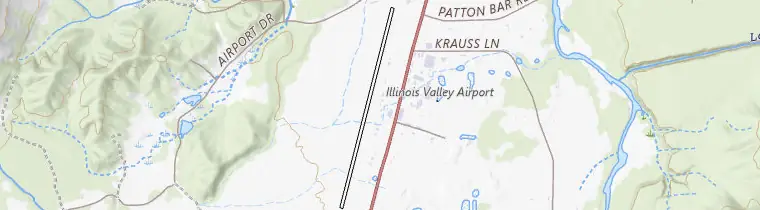
In 1943, the Forest Service expanded its new smokejumper program, firefighters who parachute in to fires that crews on foot can't reach quickly. One of the new bases started at the Redwood Ranger Station in Cave Junction and moved out to the Illinois Valley Airport after 1945. Siskiyou crews made 5,390 fire jumps over 39 fire seasons. The base closed in 1981, when the Forest Service centralized Oregon's smokejumping in Redmond.
Stuart Roosa started work at the base in 1953, as a college student. Years later he flew to the Moon on Apollo 14, carrying the tree seeds that grew into the "Moon Trees."
The base is now the Siskiyou Smokejumper Base Museum, a nonprofit run by volunteers, including retired smokejumpers who lead tours. It is listed in the National Register of Historic Places. You can see the redwood office with its old dispatch radio, 2 jump planes from the 1940s, the parachute loft (which The Oregonian called the oldest in the country in 2025), and a former mess hall full of photos.
- Season and hours: March 15 to November 15, 10 a.m. to 4 p.m. The grounds are open for self-guided visits all year.
- Cost: free. Donations help keep the buildings up.
- Where: 30902 Redwood Highway, at the Illinois Valley Airport southwest of Cave Junction. Phone (541) 441-4804.
The Oregon Caves are found
In late 1874, Elijah Davidson followed his dog, Bruno, into a hole in the mountainside while chasing a bear, and found the cave. President William Howard Taft made it a national monument on July 12, 1909. The full story, and how to tour the cave today, is on Oregon Caves.